Showing posts with label My Nyonya Food Gallery. Show all posts

Sunday, 1 January 2012

Or Kuih (Yam Kuih)

Hello everyone, the Nyonya is back. 2012 has arrived and a new year is signifies new beginnings. This year I start off my blog with a savoury dish called Yam Cake. Yam in New Zealand is also called Taro. In Penang, this cake is also known as Or Kuih.

Or Kuih is one of my favourite savoury kuih. It is made of steamed yam top off with fried dried prawns, fried shallots, spring onion, ground peanuts and red chillies to give it colour.

Method
1. Cut the yam into small chunks. Placed the yam chunks into a steamer and steam it for 40 minutes or until tender.
2. In the mean time, fried 200g of mince chicken or pork until fragrant.
3. Sieve 250g rice flour and 125g of wheat flour into a big bowl
4. Mix to the flour 2 1/2 cups of warm water until a smooth paste is formed.
5. Mash the yam up till smooth with a fork.
6. Mix the mashed yam to the smooth flour paste
7. Mix the fried mince to the yam flour paste
8. Pour the mixture into a 10inch square tin and steam for a further 40 minutes or until firm.
9. Once the yam cake is cooled and firm, remove form tin and placed on serving plate.
10. Garnish the yam cake with fried dried prawns, fried shallots, spring onions, red chills and peanuts.

Enjoy!!!


Monday, 5 September 2011

Kuih Onde Onde

Onde-Onde is one of the traditional kuihs in Malaysia. It is made from glutinous rice flour. Some recipes add in sweet potato to make the skin softer and sweeter.

The cute little rice balls are infused with pandan juice which gives it the green colour and fragrant taste. They are filled with Gula Melaka which when bitten into, burst into a mouthful of sugar surprise. Finally, the kuih is coated in freshly grated coconut which gives it a savoury taste and makes it look like Christmas during a fresh snow fall.


This kuih is not only cute but truly yummy. It is small yet it is abundant in flavours and yes once you eat one, you definitely can't stop until they are all gone.

I made ondeh-ondeh one night with my daughter and girlfriends. It was a fantastic night as my girl friends and I gathered in the kitchen and spent the night chatting and making these little delights.

I have here the end result of our nights work. Our husbands love them and I am sure you will too.


Kuih Talam


Kuih Talam is another popular kuih from Malaysia and Singpore. Talam is a Malay word meaning tray. This is because the kuih is steamed in a tray. It is made in two layers, one layer is sweet and one is savoury. The kuih is entirely opposite of the Seri Muka in terms of it's colours. The Kuih Talam has a white top and a green base whilst the Seri Muka has a green top and a white base. The Kuih Talam is also soft and jelly like whist the Seri Muka has a soft custard top with a glutinous rice base.

Both these kuihs are really yummy. They are both from the juice of pandan leave which gives them the green colour. The white tops and bottom is made from coconut cream which gives it a savoury, creamy taste and texture.

I recently got a chance to make kuih talam again for my wonderful friends from UK and so I took the opportunity to take more photos of the process of making the kuih. It's actually a simple 2 step process.

Step 1 Mix all the ingredients for the bottom layer which comprise of rice flour, green pea flour, tapioca flour and pandan juice and stir over low flame. Steam the end product for approximately 20 minutes.


Step 2 Mix all the ingredients for the top base which comprise also of rice flour, tapioca flour and green pea flour mix with coconut milk and a pinch of salt and stir slowly over low flame. Pour the thickened top base over the bottom green base and again steam for 20 minutes.


Step 3: To check if the kuih is cook, tough the top layer and if it doesn't stick to your fingers it is done.


Tang Yuan (Glutinous Rice Dumplings)

Don Zhi or winter solstice is a very important event in the Chinese custom. Dong Zhi is also known as Tang Check by the Peranakan which means the arrival of winter. It also signifies the longest night in the year. On this day the Peranakan will make Tang Yuan or Kuih Ee to signify the arrival of winter. By eating this Kuih Ee, it will mean that we will be a year older. 

In the Peranakan culture, this round shaped rice ball symbolizes togetherness and completeness of the family. The balls have to shaped till it is smooth and perfectly round. I remember when I was a child my grandmother will make me help her shape these balls. She would tell me that I have to make them as round, smooth and tiny as I can as it will mean that the my face will be as smooth and beautiful as the Kuih Ee. I was teaching my daughter how to make Kuih Ee one evening. I told her what my grandmother told me about the shape and texture of the kuih. She spent the next half hour to an hour ensuring that every ball she made was tiny, smooth and round as she wanted to ensure that her face would be beautiful when she grew up.


Tang Yuan is made of glutinous rice. In the past, they just came in pink and white and served in syrup.  These days it comes in different colours like pink, white, green, yellow, blue and orange. Some are even filled with red bean, black sesame and peanut paste. I still love the traditional ones which are simple and nice just the way they are.

My girls love them too.

Friday, 19 August 2011

Rempah Udang

Rempah udang, what can I say, this was the kuih that started it all. I was introduced to watch this soap drama called Little Nonya by my aunt and uncle who thought it was a good idea for me to learn more about my heritage. The movie is a Singapore based show which probably started its epic run on 25 November 2008. In the movie, the cho cho's favourite kuih was the rempah udang. It is a savoury kuih which can be eaten as a desert or snack or for breakfast or afternoon tea. Cho Cho loved this snack and bosom buddy was the best rempah udang maker. It was mentioned in the show that cho cho would get angry should she have to eat a poorly cooked rempah udang. So, to win her heart and thus the right to marry her grandson and great grandson, the suitors had to proof to her that she can cook and sew and of course make the ultimate rempah udang.

Rempah udang means spiced prawns in Malay. It is made from frying chopped up dried shrimps in a spice paste until fragrant. The spiced prawns are then enveloped in a casing of steamed glutinous rice and finally wrapped in banana leaves. Before serving the rempah udang is grilled over bbq or if you don't have one in a frying pan until fragrant or slightly toasted.


I found this really cool video on utube on how to make rempah udang. Check it out. Hope you enjoy this as much I as enjoyed making and of course eating it.

Saturday, 13 August 2011

Kow Chan Kuih (Kuih Lapis)

This is my fav kuih when I was younger.....what am I talking about, I am still young. Anyway, the kids absolutely love this because it is pink......what else.......no they love it because they can peal away layer by layer an enjoy the kuih bit by bit.

Kow Chan Kuih literary means nine level kuih in hokkien.

The ingredients are very simple. Rice flour, coconut cream, syrup and it taste spectacular, not too sweet. The only tedious bit of making this kuih is you have to steam it layer by layer.

I  made this kuih for my girls and now when my 2 year old sees it she straights away say "Yummy".


Friday, 12 August 2011

Pulut Tai Tai

Finally, I have been cooking since 8:00am this morning but I had some time to rest during the day to do the mummy errands like ballet class and grocery shopping. So, all in all a good day.

Mum is off to her ladies night with her pulut tai tai and home made kaya. I do hope it will be popular. Thank you mum for helping me promote my kuih creations.

So what is pulut tai tai. Pulut means rice in Malay. It is also called Blue Glutinous Rice Cakes in English. You eat it by dipping the pulut into kaya which will give it a sweet taste. In Asia the blue comes from Bunga Telang or Blue Pea Flower. We can't find the flower here in NZ so I substituted it with blue colouring.

So what are the ingredients, well all you need is glutinous rice, thin coconut and thick coconut milk and some banana and pandan leaves. You also need a lot of patience steaming the pulut.

Ingredients in pictures,

You will need to soak the glutinous rice in water overnight to soften it. It helps to cook the rice faster.


The next day, mix the thin coconut milk into the glutinous rice. Don't forget to drain the water out.


Next, steam the rice


Once the rice is cooked, put the rice into a square cake tin and cover with a banana leaf. If you don't have banana leave, you can use an aluminum foil.


Finally, once it is cool, slice it up and prepare to taste the kuih. Don't forget to put some kaya on it. Enjoy!!!

Kaya

Cooking kaya is one of my favourite things to do. The aroma that fills the house is beyond words. The smell is so tantalizing, coconut, caramalised sugar and pandan leaves. Wow, that brings me back to the days when I would go to the kopitiam with my ah kong and there I would see the ah pek and ah soh ordering black coffee with toasted kaya bread.

Kaya is one of the more versatile food. You can eat it for breakfast with a toasted bread, on a piece of biscuit or you can eat it with Nonya kuihs like Pulut Tai Tai. Let me tell you a secret, when I was young, I would just scoop the kaya and eat it on it's own. There, I said it, no wonder my ah ma always complained why the kaya was disappearing.

My mum has a ladies night today, so she has asked me to prepare pulut tai tai. Kaya is a must to go with pulut tai tai.

Kaya is very simple to make, it just takes damn long to cook (1 to 1.5 hours) and you will need to constantly stir the mixture as you don't want it to burn.

There is also only 3 ingredients, sugar, coconut cream and eggs (5 to be exact). All you need to do is mix them all in a bowl and put it on top of a double boiler and stir away for 1 to 1.5 hours.

Let me share with you what I did.....

Ingredients

Mix all ingredients together


Put the mixture on top of a double boiler


Stir away........, the mixture will slowly thickened


Once it is thickened and lumpy, stop cooking. If you like your kaya smooth, put it through the blender.

If you like your kaya a bit more golden brown, take about 70g sugar and slowly disolve the sugar until it is a rich dark golden colour. Mix the melted sugar into your kaya.

Now, slice a big fat piece of bread, toast it and get ready to enjoy your home made kaya.


I have been making more kayas and now package them to share with all of you in these 300ml containers.

Monday, 8 August 2011

Bubur Cha Cha

Bubur cha cha means dancing porridge in malay. It is made from a medley of sweet potatoes (yellow, orange and purple), yam (or taro), black eyed peas, tapioca balls and banana cooked in a sweet coconut base. Each ingredient on it's own is not very tasty, however when combined it makes a colourful, sweet and yummy dessert. Bubur Cha Cha is generally prepared on festive occasions in Penang and is a must have for Chap Goh Mei (15th day of Chinese New Year). My favourite part of the bubur cha cha is the colourful tapioca balls and the bananas. When I was younger, I would just eat the tapioca balls and bananas and leave the sweet potatoes behind. Now I just eat everything. 

So what do you need to prepare this dish?


Next, chop up the sweet potatoes and yam and steam them


Prepare the sweet syrup


Slice the bananas and mix in with the syrup


Pour in the coconut milk


Finally, once the sweet potatoes and yam are softened, combine the sweet potatoes and yam to the sweet coconut base and bananas


For those interested in watching a u-tube version of how to make bubur cha cha, see the link below

Friday, 5 August 2011

Kuih Dadar Tayap

This one is for you Amy.

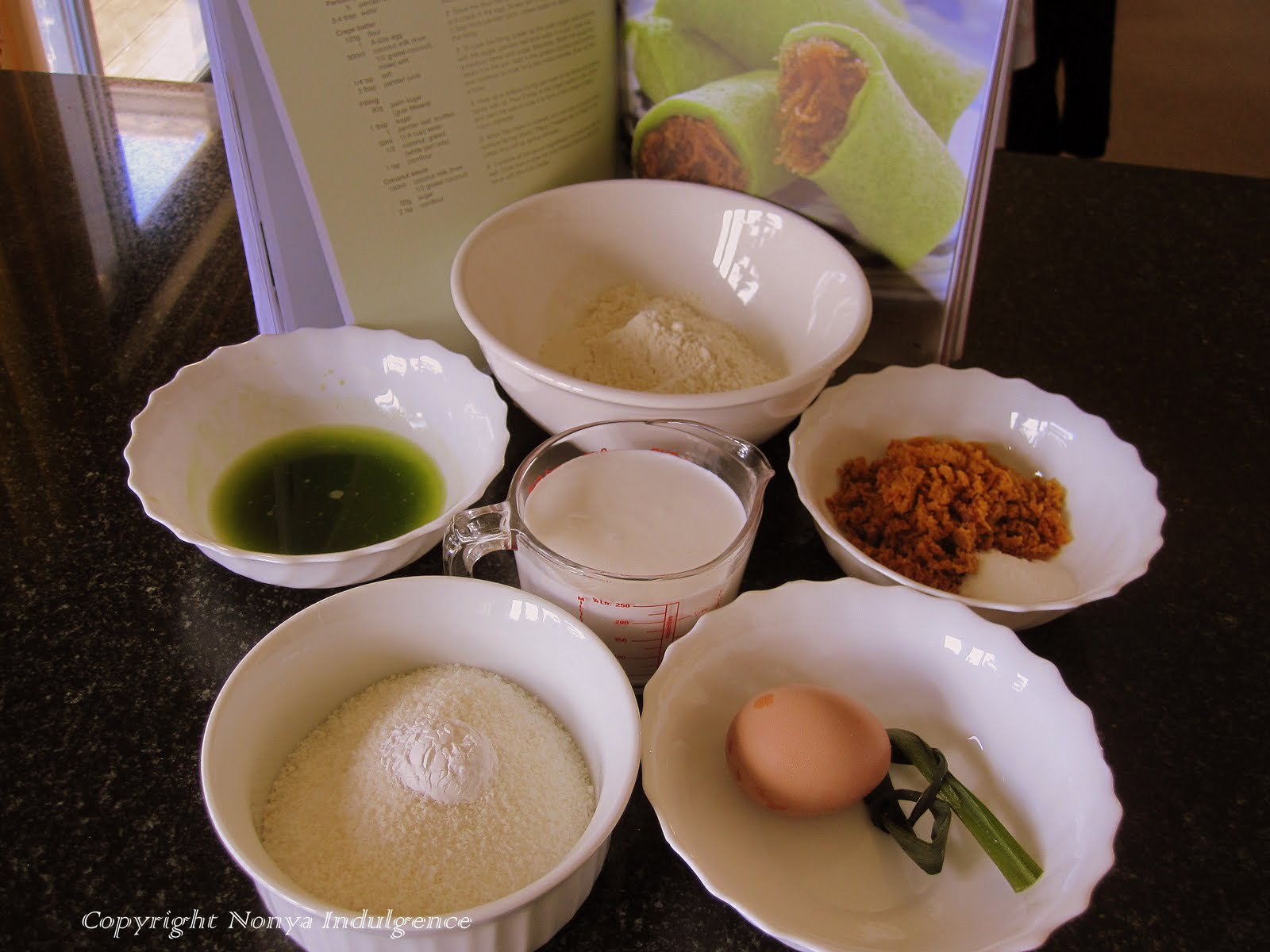
Kuih Dadar is also known as Kuih Tayap, Ketayap or Kuih Dadar Tayap. It is made with a soft green crepe flavored in pandan juice and is filled in grilled coconut infused in palm sugar.

I tried making this kuih with my daughters today. We got up early in the morning and assembled all the ingredients. After that we made the batter for the crepe and prepared the grilled coconut filling. Once the filling is cook, we cooked the crepe until it is lightly brown and crispy. The next step is to assemble the kuih. The final part is the best, eating it. It is so delicious to eat as it has 2 very different textures. The exterior is soft and silky while the interior is fragrant, slightly crispy and sweet.

First step, prepare the shaved palm sugar


Assemble the ingredients


Prepare the batter


Prepare the coconut filling


Prepare to assemble the kuih


Now prepare to eat it